ANGULAR
Complete Angular Tutorial For Beginners Introduction to Angular | What is Angular? Architecture Overview & Concepts of Angular How to Install Angular How to Create a new project in Angular Bootstrapping in Angular: How It Works Internally Angular Components Overview & Examples Data Binding in Angular Interpolation in Angular Property Binding in Angular Event Binding in Angular ngModel & Two way Data binding in Angular NgModelChange & Change Event in Angular Child/Nested Components in Angular angular directives angular ngFor directive ngSwitch, ngSwitchcase, ngSwitchDefa ult Angular Example How to use ngIf, else, then in Angular By example NgClass Example Conditionally apply class Angular ngStyle Directive Angular Trackby to improve ngFor Performance How to Create & Use Custom Directive In Angular Working with Angular Pipes How to Create Custom Pipe in Angular Formatting Dates with Angular Date Pipe Using Angular Async Pipe with ngIf & ngFor angular keyValue pipe Using Angular Pipes in Components or Services Angular Component Communication & Sharing Data Angular Pass data to child component Angular Pass data from Child to parent component Component Life Cycle Hooks in Angular Angular ngOnInit And ngOnDestroy Life Cycle hook Angular ngOnChanges life Cycle Hook Angular ngDoCheck Life Cycle Hook Angular Forms Tutorial: Fundamentals & Concep t s Angular Template-driven forms example How to set value in template-driven forms in Angular Angular Reactive Forms Example Using Angular FormBuilder to build Forms SetValue & PatchValue in Angular StatusChanges in Angular Forms ValueChanges in Angular Forms FormControl in Angular FormGroup in Angular Angular FormArray Example Nested FormArray Example Add Form Fields Dynamically SetValue & PatchValue in FormArray Angular Select Options Example in Angular Introduction to Angular Services Introduction to Angular Dependency Injection Angular Injector, @Injectable & @Inject Angular Providers: useClass, useValue, useFactory & useExisting Injection Token in Angular How Dependency Injection & Resolution Works in Angular Angular Singleton Service ProvidedIn root, any & platform in Angular @Self, @SkipSelf & @Optional Decorators Angular '@Host Decorator in Angular ViewProviders in Angular Angular Reactive Forms Validation Custom Validator in Angular Reactive Form Custom Validator with Parameters in Angular Inject Service Into Validator in Angular template_driven_form_validation_in_angular Custom Validator in Template Driven Forms in Angular Angular Async Validator Example Cross Field or Multi Field Validation Angular How to add Validators Dynamically using SetValidators in Angular Angular HttpClient Tutorial & Example Angular HTTP GET Example using httpclient Angular HTTP POST Example URL Parameters, Query Parameters, httpparams in Angular HttpClient Angular HTTPHeaders Example Understanding HTTP Interceptors in Angular Angular Routing Tutorial with Example Location Strategy in Angular Angular Route Params Angular : Child Routes / Nested Route Query Parameters in Angular Angular Pass Data to Route: Dynamic/Static RouterLink, Navigate & NavigateByUrl to Navigate Routes RouterLinkActive in Angular Angular Router Events ActivatedRoute in Angular Angular Guards Tutorial Angular CanActivate Guard Example Angular CanActivateChild Example Angular CanDeactivate Guard Angular Resolve Guard Introduction to Angular Modules or ngModule Angular Routing between modules Angular Folder Structure Best Practices Guide to Lazy loading in Angular Angular Preloading Strategy Angular CanLoad Guard Example Ng-Content & Content Projection in Angular Angular @input, @output & EventEmitter Template Reference Variable in Angular ng-container in Angular How to use ng-template & TemplateRef in Angular How to Use ngTemplateOutlet in Angular '@Hostbinding and @Hostlistener_in_Angular Understanding ViewChild, ViewChildren &erylist in Angular ElementRef in Angular Renderer2 Example: Manipulating DOM in Angular ContentChild and ContentChildren in Angular AfterViewInit, AfterViewChecked, AfterContentInit & AfterContentChecked in Angular Angular Decorators Observable in Angular using RxJs Create observable from a string, array & object in angular Create Observable from Event using FromEvent in Angular Using Angular observable pipe with example Angular Map Operator: Usage and Examples Filter Operator in Angular Observable Tap operator in Angular observable Using SwitchMap in Angular Using MergeMap in Angular Using concatMap in Angular Using ExhaustMap in Angular Take, TakeUntil, TakeWhile & TakeLast in Angular Observable First, Last & Single Operator in Angular Observable Skip, SkipUntil, SkipWhile & SkipLast Operators in Angular The Scan & Reduce operators in Angular DebounceTime & Debounce in Angular Delay & DelayWhen in Angular Using ThrowError in Angular Observable Using Catcherror Operator in Angular Observable ReTryWhen inReTry, ReTryWhen in Angular Observable Unsubscribing from an Observable in Angular Subjects in Angular ReplaySubject, BehaviorSubject & AsyncSubject in Angular Angular Observable Subject Example Sharing Data Between Components Angular Global CSS styles View Encapsulation in Angular Style binding in Angular Class Binding in Angular Angular Component Styles How to Install & Use Angular FontAwesome How to Add Bootstrap to Angular Angular Location Service: go/back/forward Angular How to use APP_INITIALIZER Angular Runtime Configuration Angular Environment Variables Error Handling in Angular Applications Angular HTTP Error Handling Angular CLI tutorial ng new in Angular CLI How to update Angular to latest version Migrate to Standalone Components in Angular Create Multiple Angular Apps in One Project Set Page Title Using Title Service Angular Example Dynamic Page Title based on Route in Angular Meta service in Angular. Add/Update Meta Tags Example Dynamic Meta Tags in Angular Angular Canonical URL Lazy Load Images in Angular Server Side Rendering Using Angular Universal The requested URL was not found on this server error in Angular Angular Examples & Sample Projects Best Resources to Learn Angular Best Angular Books in 2020

Event Binding in Angular

In this guide, we will explore the Event Binding in Angular. Event binding is one way from view to component. We use it to perform an action in the component when the user performs an action like clicking on a button, changing the input, etc in the view.

Event Binding

Event binding allows us to bind events such as keystroke, clicks, hover, touche, etc to a method in component. It is one way from view to component. By tracking the user events in the view and responding to it, we can keep our component in sync with the view. For Example, when the user changes to an input in a text box, we can update the model in the component, run some validations, etc. When the user submits the button, we can then save the model to the backend server.

Syntax

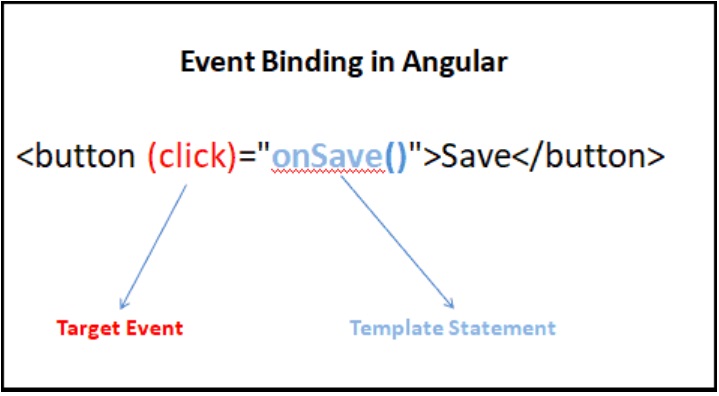
The Angular event binding consists of two parts


(target-event)="TemplateStatement"


  • We enclose the target event name in parentheses on the left side
  • Assign it to a template statement within a quote on the right side
  • Angular event binding syntax consists of a target event name within parentheses on the left of an equal sign, and a quoted template statement on the right.

    The following event binding listens for the button’s click events, calling the component’s onSave() method whenever a click occurs


    <h1 [innerText]="title"></h1>
    <h2>Example 1</h2>
    <button [disabled]="isDisabled">I am disabled</button>
    

    image

    Event Binding Example

    Create a new angular application

                                  
    g new event 


    Copy the following code to app.component.html

    app.component.html
                                  
    
    <h1 [innerText]="title"></h1>
     
    <h2>Example 1</h2>
    <button (click)="clickMe()">Click Me</button>
    <p>You have clicked {{clickCount}}</p>


    Add the following code to the app.component.ts

    app.component.ts
                                  
    
    clickCount=0
      clickMe() {
        this.clickCount++;
      }


    In the above example, the component listens to the click event on the button. It then executes the clickMe() method and increases the clickCount by one.

    Template statements have side effects

    Unlike the Property Binding & Interpolation, where we use the template expression is used, in the case of event binding we use template statement.

    The Template statement can change the state of the component. Angular runs the change detection and updates the view so as to keep it in sync with the component.

    on-

    Instead of parentheses, you can also use the on- syntax as shown below.


    <button on-click="clickMe()">Click Me</button>


    Multiple event handlers

    You can also bind an unlimited number of event handlers on the same event by separating them with a semicolon ;

    Add a new component property


      clickCount1=0;


    And in the template, call clickMe() method and then an assignment clickCount1=clickCount


    //Template
     
    <h2>Example 2</h2>
    <button (click)="clickMe() ; clickCount1=clickCount">Click Me</button>
    <p>You have clicked {{clickCount}}</p>
    <p>You have clicked {{clickCount1}}</p>


    $event Payload

    DOM Events carries the event payload. I.e the information about the event. We can access the event payload by using $event as an argument to the handler function.


    <input (input)="handleInput($event)">
    <p>You have entered {{value}}</p>


    And in the component


    value=""
    handleInput(event) {
      this.value = (event.target as HTMLInputElement).value;
    }


    The properties of a $event object vary depending on the type of DOM event. For example, a mouse event includes different information than an input box editing event.

    Remember you need to use the variable as $event in the Template statement. Example handleInput($event). Otherwise, it will result in an error

    Template reference variable

    We can also make use of the template reference variable to pass the value instead of $event.

    In the template


    <h2>Template Reference Variable</h2>
    <input #el (input)="handleInput1(el)">
    <p>You have entered {{val}}</p>


    val="";
    handleInput1(element) {
      this.val=element.value;
    }


    Key event filtering (with key.enter)

    We use keyup/keydown events to listen for keystrokes. The following example does that


    <input (keyup)="value1= $any($event.target).value" />
    <p>You entered {{value1}}</p>


    But Angular also offers a feature, where it helps to filter out certain keys. For Example, if you want to listen only to the enter keys you can do it easily


    <input (keyup.enter)="value2=$any($event.target).value">
    <p>You entered {{value2}}</p>


    Here is an interesting example. On pressing enter key it updates the value3 variable and on escape clears the variable.


    <input (keyup.enter)="value3=$any($event.target).value" (keyup.escape)="$any($event.target).value='';value3=''">
    <p>You entered {{value3}}</p>


    Angular calls these pseudo-events.

    You can also listen for the key combination


    <input (keyup.control.shift.enter)="value4=$any($event.target).value">
    <p>You entered {{value4}}</p>


    Custom events with EventEmitter

    Directives & components can also raise events with EventEmitter. Using EventEmitter you can create a property and raise it using the EventEmitter. emit(payload). The Parent component can listen to these events using the event binding and also read the payload using the $event argument.